Your CTO is managing the product backlog
Product decisions consume time meant for engineering leadership, while the boundary between product direction and technical execution stays unclear.
Fractional Product Leadership
I help founder-led teams turn competing requests into clear investment decisions, stable engineering priorities and a product function that does not depend on the founder or CTO.
Start with a focused four-week Product Foundation Sprint or bring me in as an ongoing fractional Head of Product when the business needs hands-on leadership.
I'm currently at capacity and not taking on new clients.
A recent four-week engagement
A 35-person company had seven projects underway, requests arriving through Slack and a CTO spending two days a week covering product. Nothing significant had shipped in three months.
In four weeks, the leadership team agreed three company goals, selected four items for delivery or discovery and established a recurring process for future investment decisions.
Read the full case studyThese problems often appear together when a company has engineers but no clear product leadership. Each one needs more than a new prioritisation template.
Product decisions consume time meant for engineering leadership, while the boundary between product direction and technical execution stays unclear.
Every initiative has a persuasive sponsor, but the team has no shared goals or evidence-based way to decide what should be funded and what should stop.
Too much work is in progress, priorities change through side conversations and new requests arrive faster than the team can finish existing commitments.
The team can deliver, but it cannot resolve customer requests, trade-offs or roadmap questions without the founder stepping into every conversation.
Max Antonov
Product and technology leader · Sydney
I've taken companies from early traction through growth, improving how teams find the right problems and make faster decisions, then ship with consistency. Based in Sydney, available remotely worldwide.
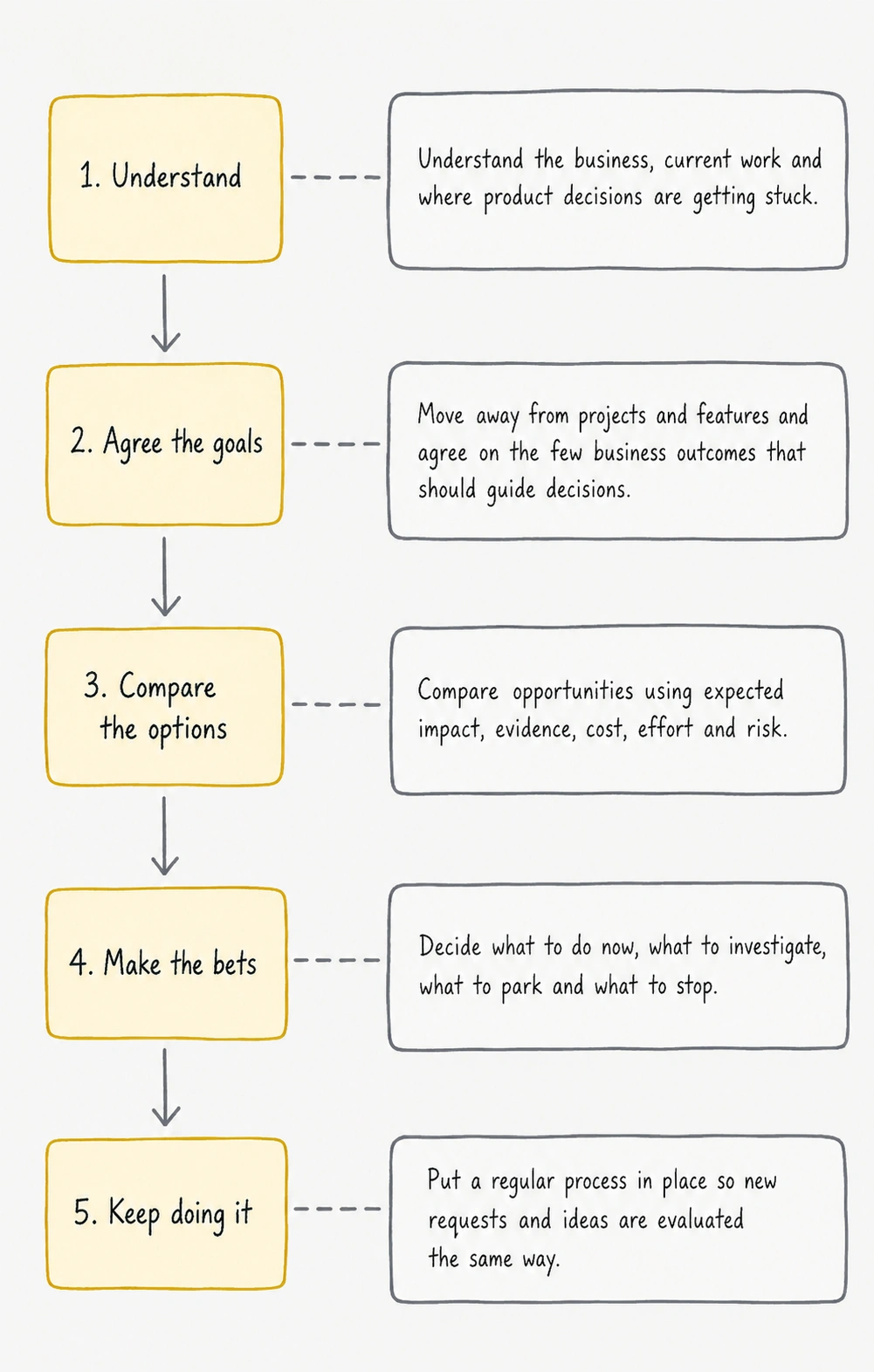
I join the leadership conversation, review the current idea list with the team and make the cost, evidence and expected value behind each option visible. Together we separate genuine commitments from untested requests and narrow the list to a small number of priorities everyone can explain.
The result is a practical operating rhythm your team uses to make decisions and finish meaningful work. In an ongoing engagement, I stay close to delivery week to week while building the internal capability to operate without me.
Bringing in product leadership should help the CTO succeed, not sideline them. I work with the CTO to clarify the boundary between choosing the right things to build and building those things well. Their technical knowledge and delivery experience stay central to the decisions.
Leadership, product and engineering know which decisions they own and where they work together.
Ideas are assessed using the same language for value, cost, evidence, confidence and risk.
Engineering can plan and finish meaningful work without priorities changing through side conversations.
The team learns how good product decisions are made instead of becoming dependent on an external adviser.
15+ years
Across product and engineering, from lead engineer to product director.
7 companies
HealthShare, Backpocket, Brighte, The Iconic, Hoyts, News Corp, Yahoo!7.
3 industries
Regulated healthtech, fintech, and large-scale ecommerce, across subscription, marketplace and transactional models.
Director level
Portfolio strategy, capital allocation and product governance, reporting to CEOs.
Most relevant if that looks like your situation now: product decisions spread across a founder or CTO who is already stretched thin, engineering busy but without a clear product owner and no one accountable for what gets built next.
I started as a software engineer before moving into product leadership. That helps me work credibly with CTOs and engineers while connecting technical investment to customer and commercial outcomes.
Fractional product leadership works best when you have a capable team but no one clearly accountable for product direction and the decisions behind it.
Good fit
Not a fit
Product direction no longer consumes days meant for engineering and platform leadership.
The team finishes meaningful work before new requests create another competing priority.
Leadership knows why engineering capacity is being spent before development begins.
The team can resolve trade-offs without you sitting in every product conversation.
Large requests become evidence to assess, not commitments that automatically enter the roadmap.
Leadership and engineering share a small set of bets they understand and can deliver.
The Product Direction Review is the clearest starting point when you need to understand what is actually causing the prioritisation problem before committing to more. From there, a Product Foundation Sprint builds the roadmap and operating rhythm, and I can stay on as ongoing leadership if the business needs it.
Recommended starting point
Diagnose what is actually causing the prioritisation problem, work through the current portfolio with the CEO/CTO, and leave them with recommendations about what to stop and change.
A$999 + GST
A four-week, two-days-a-week sprint that turns a messy idea list into an agreed, evidence-backed roadmap and the operating rhythm to keep it current.
2 days per week for 4 weeks. Fixed scope and fixed price.
I work hands-on with founder-led teams to build the product function, or step in as a fractional Head of Product when experienced leadership is needed now without committing to a full-time hire.
Usually one to three days per week, billed monthly.
You can move into ongoing leadership after a Product Foundation Sprint or start here when the need is already clear. A 30-minute conversation is enough to work out which path fits your situation.
I'm currently at capacity and not taking on new clients.
Mostly seniority and scope. A fractional product leader typically operates at Head of Product level across discovery, prioritisation, and delivery. A fractional CPO adds executive responsibilities such as portfolio strategy, investor communication, and team design. For many founder-led Australian companies, the work overlaps and the title matters less than the mandate.
A strategy consultant usually delivers a recommendation or defined output. A fractional product leader stays embedded, makes decisions with the team, and owns outcomes week to week. A focused Product Foundation Sprint can solve a specific strategy and roadmap problem without requiring an ongoing engagement.
Typically one to three days per week, depending on the scope and the team. I limit the number of simultaneous engagements so I can stay close to the decisions and delivery work.
Engagements are month-to-month, with 7 days' notice. Most engagements run for 2-3 months and can extend from there. The Product Foundation Sprint is a separate fixed four-week engagement.
Yes. I can make product strategy legible to investors and boards through a clear narrative, a credible roadmap, and defensible prioritisation. I can also help leadership answer difficult questions about product direction, risk, and return.
Both. I am based in Sydney and can work in person with Sydney teams. I also work remotely with companies across Australia and internationally.
The Product Foundation Sprint produces an agreed, evidence-backed roadmap, clear reasoning behind the priorities, and a practical decision model and review cadence the team can keep using. The output is working material for the team, not a slide deck that sits unused.
Yes. I can establish the initial decision process, clarify responsibilities, work through the existing idea list and help define the permanent role. If an ongoing hire becomes the right next step, I can help shape the role, assess candidates and support the handover.
The aim is to clarify responsibilities, not sideline the CTO. I work with them to separate product direction from technical execution, establish where those responsibilities overlap and give engineering better supported, more stable decisions to act on.
I work with tech-enabled businesses where software is central to how the company creates or captures value. If you are building a product or platform, the model is likely relevant even if the company does not describe itself as a technology business.
On product, AI and how the two collide.
For most of the last decade, the hard part was building software. Engineers were needed, e...
Most teams don't have a decision-making problem. They have a decision-conditions problem....
I spent the first few years of my career as a software engineer before I discovered produc...
A lot of product strategies I've seen were mostly either a vision, a roadmap, or some vari...
Tell me what is happening in the business and where product decisions are getting stuck. We'll work out whether an ongoing engagement, a focused sprint or neither is the right next step. No pitch, no pressure.
I'm currently at capacity and not taking on new clients.
