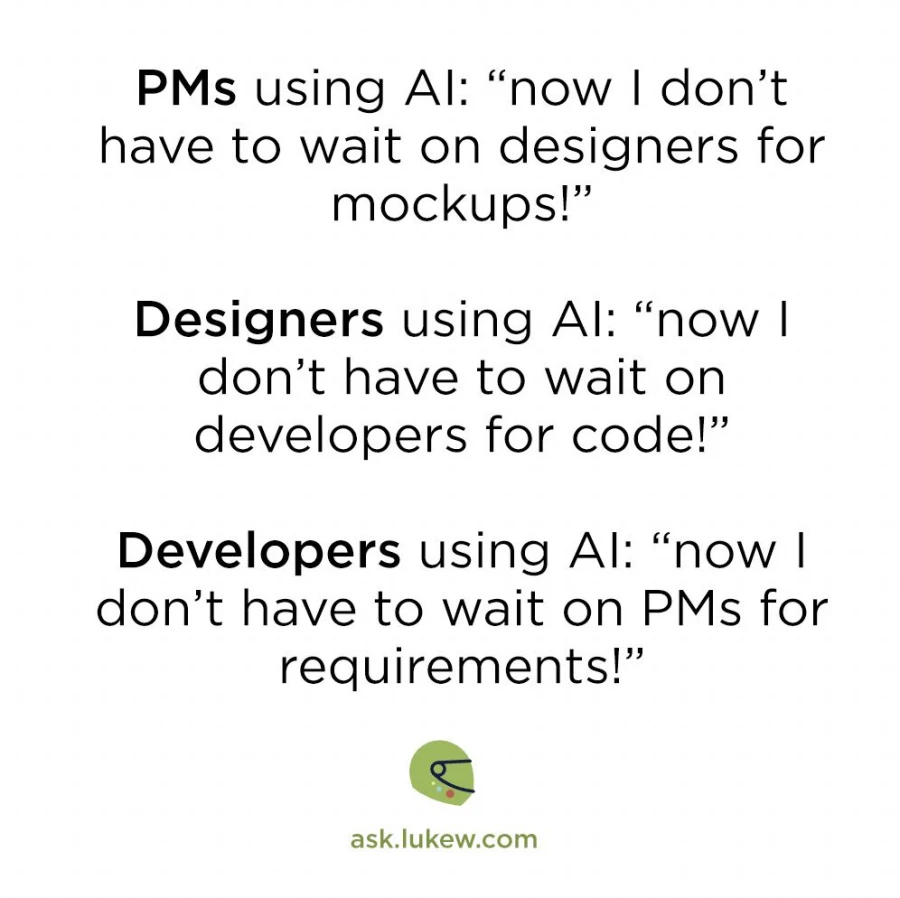
The other day, Luke Wroblewski wrote something that made me think not only about how AI speeds up teams, but also about how it changes the way software is made and sold. Most teams don't realise how big of a deal this is.
It sounds like a productivity hack at first because everyone is getting unblocked. And people who work in technology can feel it the most right now.
You can quickly create a rough user flow that covers all the edge cases you might miss because your brain likes to shut down at 4:59 pm, all without touching FigJam.
You can ask it to look over your messages and CTAs before you share them, write better and clearer specs and acceptance criteria in five minutes than you used to be able to in two hours...and the list goes on.
It's clear that the time between idea, artefact, and feedback is getting shorter, but what does that mean? Where is it going?
#1 Individual Speed Becomes Universal
This is a clear one. It's the speed. You don't have to block someone's calendar, wait for a response, or "take people on the journey" to move forward. You can do it all by yourself, from start to finish.
But there are two important things to add:
- Less energy is needed to start, so it doesn't feel like pushing a stalled car uphill anymore.
- More parallel exploration: instead of arguing about one direction all week, one person can spin up five and see which one actually works.
Tech teams will work faster. And with speed comes a change in who is responsible.
You have more freedom and control over the direction if you can move without waiting.
Depending on the size of the product, each team member, whether they are a designer, engineer, or product manager, will be responsible for a part of it or a specific metric.
All jobs that require a lot of coordination become weaker, and end-to-end operators gain power.
#2 The Cost of Building Collapses
With the same team and same number of people, they ship a lot more because AI lowers costs and speeds up cycles. Most of the work will be done by AI agents, and in many cases, it already is.
The cost of running an online business starts to go down:
- Less support staff: The most likely place to lose a job is in customer service or account management.
- The same amount of work that used to take 20 people will soon take 4.
- The cost of entry goes down a lot
The question changes from "Can we build it?" or "Should we build it?". Let's just do it because we can and it's cheap.
#3 Supply Goes Up
You don't need to work for a big company, raise a lot of money, or hire a lot of engineers if everyone can ship and everyone will ship.
The era of the solopreneur is speeding up, and more people are starting to build. Solopreneurs start software companies, and micro-tools pop up in every niche. Features are copied in weeks, not quarters, and every niche quickly gets hundreds of options.
When everyone can ship, shipping is no longer a barrier.
Software is no longer hard to find, and this changes how businesses compete.
#4 Margins Compress
More supply always puts pressure on prices, and in some markets, it leads to a race to the bottom.
SaaS that doesn't stand out is the most vulnerable layer. These are products that are built on workflow, CRUD, and a dashboard, but they don't have a community, data, or ecosystem moat.
As the cost of building goes down, the profit margins go down.
When margins get smaller, the logic behind valuation changes.
As the logic behind valuing things changes, capital becomes more picky.
The middle layer of SaaS will be the first to feel this.
#5 Changes in Scarcity
There are a lot of software on the market.
What stays rare?
Trust. Community. Distribution and Ecosystem.
There is no end to software.
AI agents will ironically compare features, prices, and reviews in just a few seconds.
Differentiation must be easy to read right away.
What this means
Let's be honest:
- The PM who handles tickets can be replaced with AI
- AI will replace the engineer who only writes code based on specs and acceptance criteria.
- AI will replace the designer who only makes screens.
- You guessed it: the data analyst or scientist who only runs predefined queries and pulls reports can be replaced with AI.
Of course, this sounds really uncomfortable to me, and I'm sure it does to you too. But that's because we're going through a change and there are a lot of things we don't know about what's ahead.
Hopefully, in five years, it will feel normal.
We don't expect anyone to walk down the street and light gas lamps by hand anymore, just like we don't expect them to do it today.
This is the biggest change in AI and product development in a long time.
Let's be honest: we can't stop it, but you can improve your chances of making it in this new world.
- Start building right away. Don't wait. Make small tools that make your own work easier or that can take the place of SaaS you already pay for. Use Codex. Use Claude. Use any stack you want, but make sure you know the basics.
- Optimise for distribution early on. In a world of too much supply, just having a good product won't cut it this is why product-led growth
 Product-Led vs Sales-Led Growth: How to Choose the Right GTM MotionPLG vs SLG: when each model works, when it doesn't, and how to choose the right growth motion for your product stage, deal size and buyer type. has become the default motion for software teams that can't rely on sales headcount alone. Audience, credibility, and access are more important than ever.
- Features can be copied, but distribution, brand, community, proprietary data, and ecosystem integration grow over time.