
I'm a father of 3 from Sydney, a product and technology leader. I write about leadership, product management, technology and the messy reality of making work work.
I'm currently building and experimenting with a mildly alarming number of things. I also work as a fractional product leader, stepping in where the founder or CEO is still carrying product decisions on their own, and offer 1:1 product leadership coaching for senior PMs and emerging product leaders. I founded SoundingBoard, practical peer exchange for product people. Connect via LinkedIn, or follow me on X.
Subscribe to the best posts on product, strategy, and AI. Just one email a month.
AI & Product
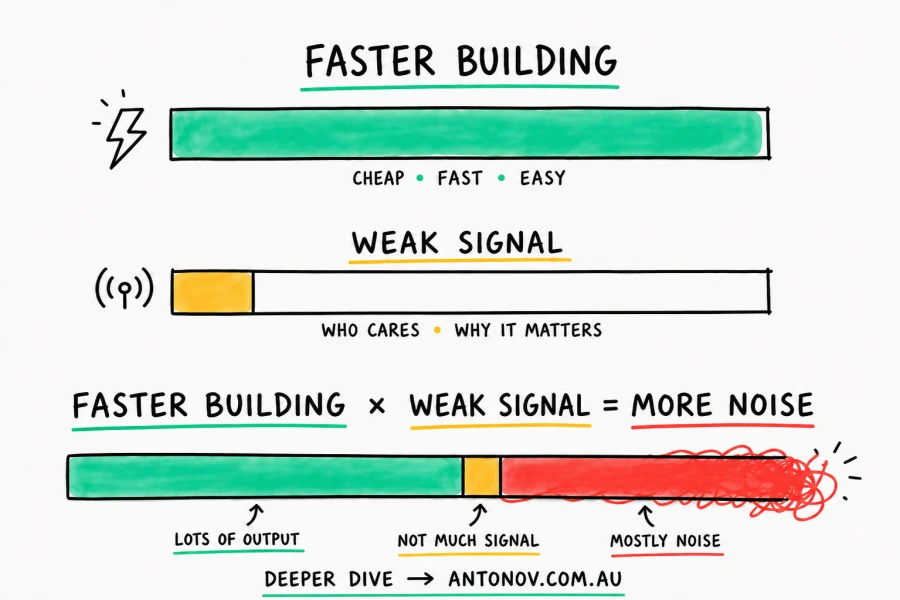
For most of the last decade, the hard part was building software. Engineers were needed, estimates had to be accurate, and enough cash had to be raised to reach the market before competitors did. That constraint is largely gone. Building is cheap now, at least compared to what it was.
You can build things quickly now (which is amazing b/c it helps more people enjoy software development). Figuring out if anyone cares is the part that still takes time. Who it matters to, and why it matters enough to compete for their attention in a market that just got ten times more crowded.
That's a product problem. And it changes what product management is actually for.
My take
At the moment a lot of teams are using AI to speed up operations side of the business: faster research and specs, better meeting notes, drafting tickets, etc. Fine. All true. But it doesn't change the core problem. I've seen teams get insanely fast but it didn't make the product any better. In fact they made the product worse...faster!
Anyway, the deeper change is in team structure. Teams are getting smaller. One person covers what used to take three or four, and most companies are only starting to figure out what to do with that.
PMs are shipping code. Designers are building features without a handoff. Everyone is becoming a builder, whether or not that's what the job description says.
And you don't need to raise money, join a big company or spend a year hiring engineers if you can just build. The old path to market got a lot shorter.
So more people start. Solopreneurs launch software companies. Micro-tools pop up in every niche. A feature that used to take a competitor a quarter to copy takes two weeks now, sometimes less.
Every niche fills up faster than people expect. When everyone can ship, shipping is no longer the barrier. Software is no longer hard to find and this changes how businesses compete.
What AI means for how software is built and sold
- AI Just Removed the Waiting. Now What? - What happens when individual speed becomes universal and every niche gets ten products at once. The structural shift most teams are treating as a scheduling problem.
- AI Agents Don't Care About Your Polished UI - The era of competing on interface is ending faster than most PMs have noticed. What it means to treat your API as the actual product.
- Your Users Are Becoming Agents - When software starts navigating on your behalf, clean CTAs become obstacles more than they are differentiators. What that does to product design.
- Vibe Coding - Why cheap, fast experimentation beats quality at the hypothesis stage, and why AI makes that argument harder to dismiss.
- How to Differentiate Your Product When AI Can Copy Your Features Overnight - When features can be replicated in a weekend, the moat has to be something else. What actually stays rare and why most teams are building the wrong thing right now.
What AI means for product managers specifically
- No Place to Hide - AI is exposing PMs who've been surviving on templates and ticket hygiene. The ones who shape bets and ask better questions are fine. The ones who don't are already being outpaced.
- Get Comfortable Being Uncomfortable - Strategy in the AI era is messier and faster. PMs who wait for certainty before moving will manage projects, not build products.
- The Future of Product Managers - Whether the PM role survives this depends entirely on what the PM is actually doing. Execution work is vulnerable. Judgment work is not.
What AI means for founders and builders
- Building Optional Income in the AI Era - A first-person account of running side experiments when building is cheap and the real constraint is getting anyone to find it. Includes the YouTube channel I'm currently testing.
Creativity, ownership and AI-generated work
- Prompted Vision - Whether AI-generated work is "yours" comes down to intent rather than process. You're choosing the vibe, the story, the framing. That's direction. That's still creation, I think.
FAQ
Will AI replace product managers? Not the good ones. I've sat with that question long enough to be reasonably confident it's not a cop-out. AI is replacing the task management layer: ticket writing, meeting summaries, spec drafting, etc. The product managers in demand will be those who possess better judgment. They're also the ones who can ship. As teams shrink, the coordinative PM is gone, and the ones who can think and build stay. The product managers most at risk of losing a job are the ones whose value was mostly coordination and documentation, and they probably already know it.
Should product teams be using AI tools right now? Yes, but thoughtfully rather than reflexively. Using AI to move faster on things that already matter is real leverage. Using it as a substitute for knowing what matters is just noise moving faster, which might actually be worse than slow. Before adopting any AI tool in a product workflow, it's worth asking whether it frees up time for judgment or just creates more output that still needs judgment applied to it. Most of the time it's the second one and people talk themselves into calling it the first.
How does AI change Product-market fitThe point at which a product is solving a meaningful problem for a market strongly enough to create sustained demand.Learn more? It makes the supply side of every market more crowded, faster than the demand side can absorb. Finding PMF used to partly be a function of getting to market before competitors could copy you. That window is shorter now, shorter than most founding teams are pricing into their runway plans. What's become more important is something like distribution fit: whether the people who need your product can actually find it, trust it and talk about it. Technical differentiation is harder to sustain than it used to be. Audience and trust are harder to copy than any feature you can ship.
What's the difference between using AI and being AI-native? Using AI means adding it to an existing workflow. Being AI-native means designing the workflow around what AI can do, which sounds like a subtle distinction until you see it in practice. An AI-native product team might prototype on a Tuesday afternoon, run five experiments a week and treat a weekend build as a real test rather than a proof of concept. The difference shows up in speed of learning, not just speed of output. Most teams haven't made that jump yet. I haven't fully made it either.
Does AI change what makes a good Product strategyA set of choices about where a product will compete, which problems it will focus on and how it expects to win.Learn more? The fundamentals don't change. A good strategy still means making a real choice about what you will and won't do, and holding that choice under pressure. But AI makes execution cheaper, which means bad strategies get tested faster and fail faster. That's actually useful if you're paying attention. The teams that will compound advantage are the ones who can run more bets, learn quickly from the ones that fail and stay disciplined about doubling down only on the ones that show real signal. The ones getting left behind are mostly treating every failed experiment as a reason to change direction rather than sharpen it.
If you're a founder trying to work out what AI means for your product direction, or a PM trying to figure out what this shift means for your role, I'm happy to talk. No pitch. Just a thirty-minute conversation about where you are and what's worth focusing on.
