Every time someone says that a Product Manager or a Product Designer or even a leader needs to have taste, I want to ask: "Whose taste exactly?"
The founder's? The current market leader's? Steve Jobs? Nobody ever specifies.
And it doesn't occur to most people to ask whether the designer who spent fifteen years at Apple, the loudest voice in every product review or the VC on Twitter who's never shipped a thing might have completely different answers. Of course, they do.
Haute couture at least makes the weirdness obvious. Take a look at a Rick Owens runway piece and you'll think it's interesting, somewhat provocative and technically impressive. Maybe even influential but slightly strange.
Something in that shape shows up 5-10 years later, if at all, in clothes that people actually wear. But would you wear it to Woolworths on a Tuesday evening?
I'd say not and even if you would, does that mean you have better taste or worse taste? And if you ask Woolworths shoppers about your outfit, most of them will tell you: "That outfit looks weird but good on ya, mate!"
Nobody would ever say: "I don't have good taste."
Actually conceding the thing: "I lack taste" or "I've never had good taste". It doesn't happen, especially in the professional world.
Go to a product or design review and you'll notice that everyone believes they have it, so the word is entirely self-awarded.
When a PM says: "It's lacking taste" they usually mean a few different things. They don't like the style. They think it looks low-status.
What feels like great design in a consumer app can be dead wrong in healthcare or B2B. The user has usually done the job for years. They do not want to be impressed. They want the thing to work.
Move this to an app that a GP uses, and that would annoy the shit out of them as it disrupts their flow, which is optimised for time.
Context is where it stops being about looks.
Take a CPO who has spent a few years in the consumer space; they pick up a few habits that are great for the space but hard to unlearn...don't ask the user to enter too much date during the first session; help them to get to that magical "aha" moment that will move them from an "acquired" to an “activated” user and hide as much of the system's complexities.
Those are good instincts for that market.
As soon as the CPO joins a company in the healthcare space, for example, they extend the budget for "surprise and delight". The team gets a new direction and burns a sprint trying to make it feel more elegant. Cool, now a GP is in and out of a screen in 4 seconds instead of 1, but they've seen a cool animation. Guess what? GPs hate it.
"Taste" sounds like quality. If you push back, it can sound like you're saying: "Hey, let's make it worse!"
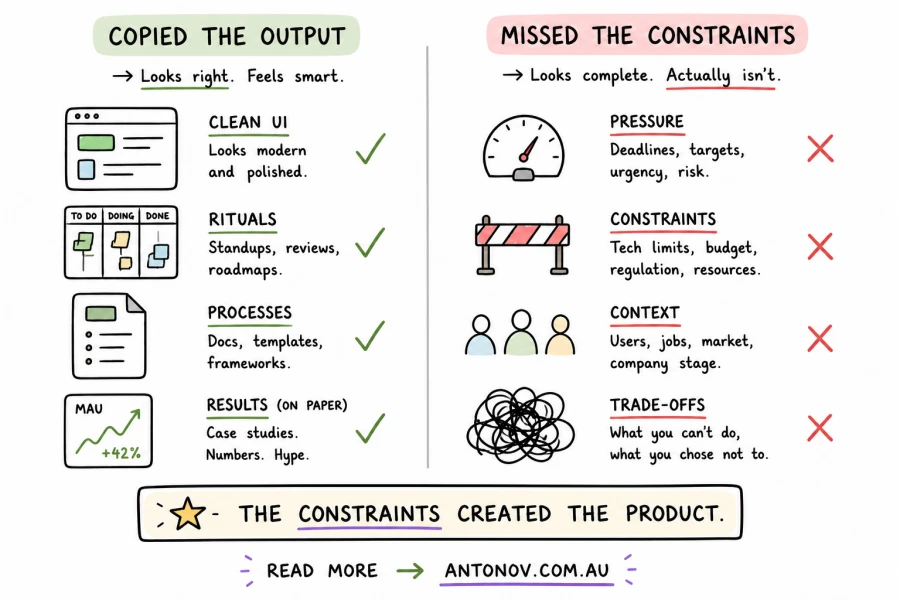
I've seen product teams copy the processes and look of great companies, but not the pressure and constraints that created them. Yep, you can easily replicate rituals but the conditions that made those rituals useful, you can't.
A great CPO sometimes approves things they personally dislike because they can see the choice behind it. They can see what was gained, what was lost, and why "I wouldn't have done it that way" is not the same as "that was wrong."
This is a harder skill than taste and a less glamorous one. It does not come up much in job descriptions.
It took a few years of watching this play out before I stopped reaching for the word at all.
"Taste" tells you what someone finds beautiful. Which is fine. It's just not particularly useful information about whether they'll make good decisions.