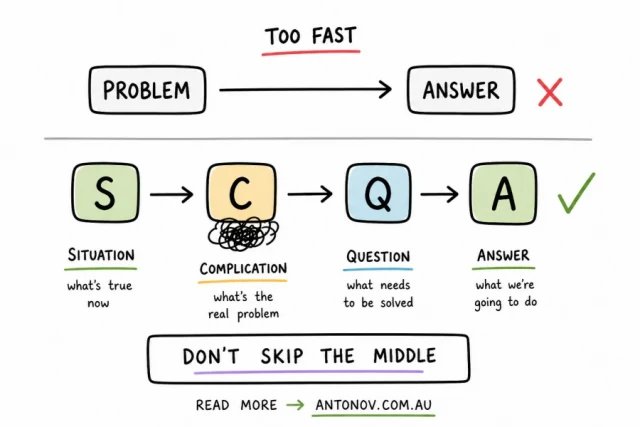
In this fictional (or maybe not so much) story, you might recognise some common patterns. Alex, a Senior Product Manager, has just over 50 items on the Product roadmapA view of the product investments, problems or outcomes a team expects to work on over time.Learn more. Seven of them are marked as urgent and important. Three stakeholders want different but arguably the most important things to ship by the end of the quarter (as they have different incentives and different goals), and the engineering team lead has just asked, politely but firmly, for the team to stop being pulled in many directions at once.
This is the part of the job that no one really talks about.
Frameworks look clean on slides. The room where decisions actually happen isn't. Everyone is trying to fight for product and engineering time.
Here's how the SCQA frameworkSCQA Framework Explained: Situation, Complication, Question, AnswerStructure any argument in 4 steps: Situation, Complication, Question, Answer. The SCQA framework used by McKinsey consultants with examples and a template. cuts through it.
Situation: Before anything gets prioritised, Alex anchors on what's real.
Not the plan or the roadmap.
What the data says, what customers are pushing for, and where the market is actually moving.
It's always tempting to jump straight to the features everyone's asking about. Resisting that instinct is probably the most important part of the whole exercise but of course it's a bit scary becuase it might lead to some conflic.
Complication: There's limited product and engineering capacity. Perhaps, a bit of technical and product debt, a lack of data points. There was a roadmap inherited from a previous PM that nobody fully believes in anymore. The SCQA frameworkA writing and communication structure built around the Situation, Complication, Question and Answer.Learn more helps smooth tensions and name them clearly.
Question: Then Alex cross-references the key points, what the business is trying to achieve, talks to the wider teams, looks at drop-off data, and asks the question: What should we do next and why?
Answer: A set of bets with reasoning attached. (As a PM, always provide your rationale even if you think it's wrong. If it is, it's probably because you were missing some context, so use it as an opportunity to learn.) Alex lands on 3 things she can defend in a room, each with a clear line back to a specific customer pain and/or business outcome. Some things get cut not because they're bad ideas but because a half-built feature is worse than nothing.
The SCQA structure gives Alex something to return to rather than starting from scratch each time - which is probably the most practical thing about it, though I'm not sure that's obvious from the outside looking in.
If you want a one-page version to work from, the SCQA cheat sheet has the template.
Sometimes you think you have a good strategy in place, but when you ask around the company and ask people to point out the three things we're focusing on and wh...
A company I spoke with last quarter had their AI strategy ready. Slides, a dedicated section, a product vision that was going to be powered by AI. The founder h...
I ran a strategy audit for a company where the CEO was convinced they had a strategy but the team couldn't follow it.
The deck was about 10-12 slides. Three of...
I'm a father of 3 from Sydney, a product and technology leader. I write about
leadership, product management, technology and the messy reality of making work work.
I'm currently building and experimenting with a mildly alarming number of things. I also work as a
fractional product leader, stepping in where the
founder or CEO is still carrying product
decisions on their own, and offer 1:1
product leadership coaching for senior PMs and emerging product leaders. I founded SoundingBoard, practical peer exchange for product people. Connect via LinkedIn, or follow me on X.
Subscribe to the best posts on product, strategy, and AI. Just one email a month.