I ran a strategy audit for a company where the CEO was convinced they had a strategy but the team couldn't follow it.
The deck was about 10-12 slides. Three of them were the executive summary. There was a vision statement, a set of priorities and a slide about strategic focus areas that listed 7 (seven) things. Yes, 7.
I asked the CEO which of those 7 they'd be willing to cut if they had to pick two things to actually win at.
They said they were all important.
That's usually where I start.
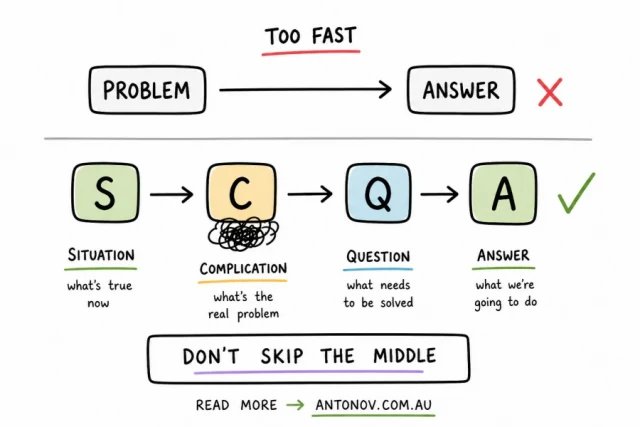
I've been in this conversation more times than I'd like or you'd expect these days, with so much information on strategy available - if you want to see how the framework plays out in a real scenario, SCQA in practiceSCQA Framework in Practice: A Product Prioritisation ExampleHow a product manager uses the SCQA framework to cut through a cluttered roadmap a worked example covering Situation, Complication, Question and Answer. walks through a prioritisation example from start to finish.
A company that's been operating for a few years, doing well enough but starting to feel the gap between what's on the Product roadmapA view of the product investments, problems or outcomes a team expects to work on over time.Learn more and what actually seems to matter. The team is busy, that's cool. But the work doesn't quite connect to anything bigger, things feel a bit slow to ship and the smart people in the room can't always articulate why.
They almost always have a strategy document. In my experience, that's not the problem.
The pattern I keep seeing is that the document describes what the company wants to achieve - like business goals, say 30% revenue growth - not how it's going to get there and why that approach makes sense given the actual situation. Sometimes the how is articulated but too low-level, without a lot of confidence that the problem is worth solving or the solution will work. Example: build a feature for users to create an account.
Goals and strategy look the same on a slide. They feel the same in the room. The difference only becomes obvious when you try to use the strategy to make a real decision and it doesn't actually help you.
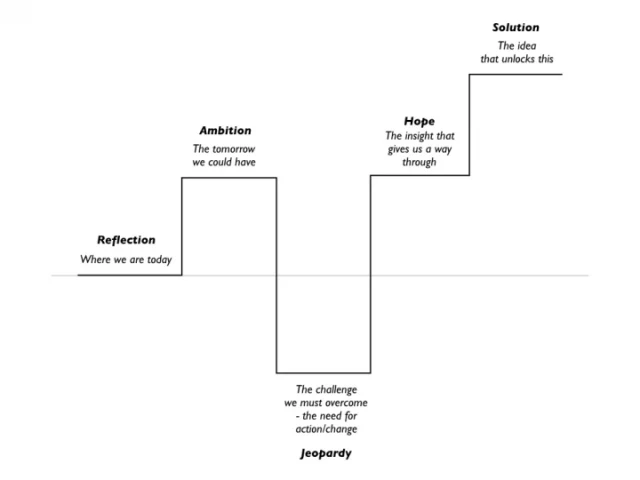
Rumelt calls the core of it the kernel. His version has three parts: diagnosis, guiding policy and coherent actions.
The part companies skip is usually the first one. They go straight to priorities and roadmaps and Objectives and Key ResultsA goal-setting framework that pairs a clear objective with measurable results showing whether progress was made.Learn more, as though the hard work is deciding what to do rather than understanding what's actually happening.
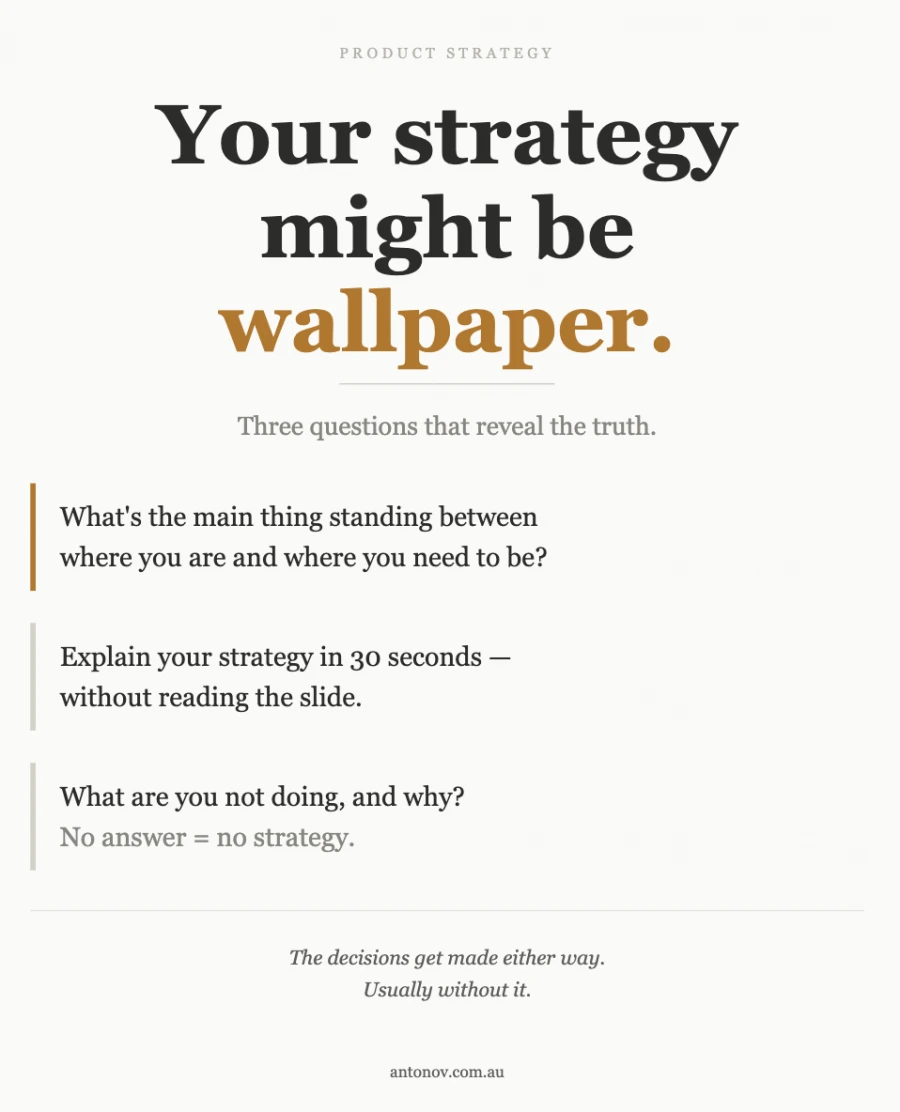
So when I sit down with a team, I start with the diagnosis. Not "what are you trying to achieve?" but something more uncomfortable: what do you think is the main thing standing between where you are now and where you need to be?
The answers are usually revealing and not always in the way you'd expect. Sometimes the CEO and the execs give different answers.
Sometimes the answer is clear and the strategy is actually fine and the problem is somewhere else entirely.
Sometimes the person giving the answer pauses for a long time before they speak, which is its own kind of signal. Or they deflect. Again, quite telling.
The second question is simpler. I ask them to explain the strategy to me as though I'm a person who doesn't know the company in 30 seconds (elevator pitch, essentially). Not to read it off the slide, just explain it.
Some have a good clear answer and some start rambling, referencing business goals and opportunities but struggling to articulate the 1-3 bets the company is focusing on.
Which tells you something. A strategy you can't explain from memory isn't guiding decisions yet. It's wallpaper - relatively expensive wallpaper at that. If the execs can't explain this, imagine what's happening on the team levelWhy PMs Aren't Driving Strategy (And Why Workshops Won't Fix It).
The third question is the hardest to ask without sounding confrontational: what are you not doing and why?
A strategy without explicit trade-offs is just a list of good ideas arranged neatly. The trade-off is where the strategic thinking actually lives. "We're not going after enterprise right now because..." or "We're building depth in this use case rather than expanding to adjacent ones because..." Those sentences reveal whether the thinking happened or just the slide-making did.
After those three questions I usually have a clear enough picture. Either there's a real strategy underneath the document and the problem is how it gets communicatedHow to Craft a Strategy Narrative That Inspires Action (the SCQA frameworkSCQA Framework Explained: Situation, Complication, Question, AnswerStructure any argument in 4 steps: Situation, Complication, Question, Answer. The SCQA framework used by McKinsey consultants with examples and a template. is a useful structure I've found for that) or the document is filling the space where a strategy should be and the hard work hasn't happened yet.
The second situation is more common, at more companies than will admit it. It's also completely fixable, which I think is the thing worth knowing.
The diagnostic part of a strategy is slow and uncomfortable. It forces you to say things out loud that felt fine as assumptions. It's where the whole rest of it gets grounded - and the companies I've seen try to skip past it tend to do the diagnosis a year later anyway, just with more sunk cost built up around the wrong thesis.
Right. The last thing I check is whether the team can connect their actual prioritisation decisions back to the strategy. Not every decision. The significant ones. "We chose X over Y because our strategy says we're competing on Z" is a sentence a well-aligned team can produce without hesitating. If nobody can produce it, the strategy document and the real work have separated from each other and the gap is almost certainly growing.
When that happens it's usually not a process failure. The strategy just hasn't done its job yet.
Sometimes you think you have a good strategy in place, but when you ask around the company and ask people to point out the three things we're focusing on and wh...
A company I spoke with last quarter had their AI strategy ready. Slides, a dedicated section, a product vision that was going to be powered by AI. The founder h...
A couple of years ago I sat in a strategy workshop where a facilitator spent about an hour walking product managers through where they sat in the market, opport...
I'm a father of 3 from Sydney, a product and technology leader. I write about
leadership, product management, technology and the messy reality of making work work.
I'm currently building and experimenting with a mildly alarming number of things. I also work as a
fractional product leader, stepping in where the
founder or CEO is still carrying product
decisions on their own, and offer 1:1
product leadership coaching for senior PMs and emerging product leaders. I founded SoundingBoard, practical peer exchange for product people. Connect via LinkedIn, or follow me on X.
Subscribe to the best posts on product, strategy, and AI. Just one email a month.