
I'm a father of 3 from Sydney, a product and technology leader. I write about leadership, product management, technology and the messy reality of making work work.
I'm currently building and experimenting with a mildly alarming number of things. I also work as a fractional product leader, stepping in where the founder or CEO is still carrying product decisions on their own, and offer 1:1 product leadership coaching for senior PMs and emerging product leaders. I founded SoundingBoard, practical peer exchange for product people. Connect via LinkedIn, or follow me on X.
Subscribe to the best posts on product, strategy, and AI. Just one email a month.
Product Strategy
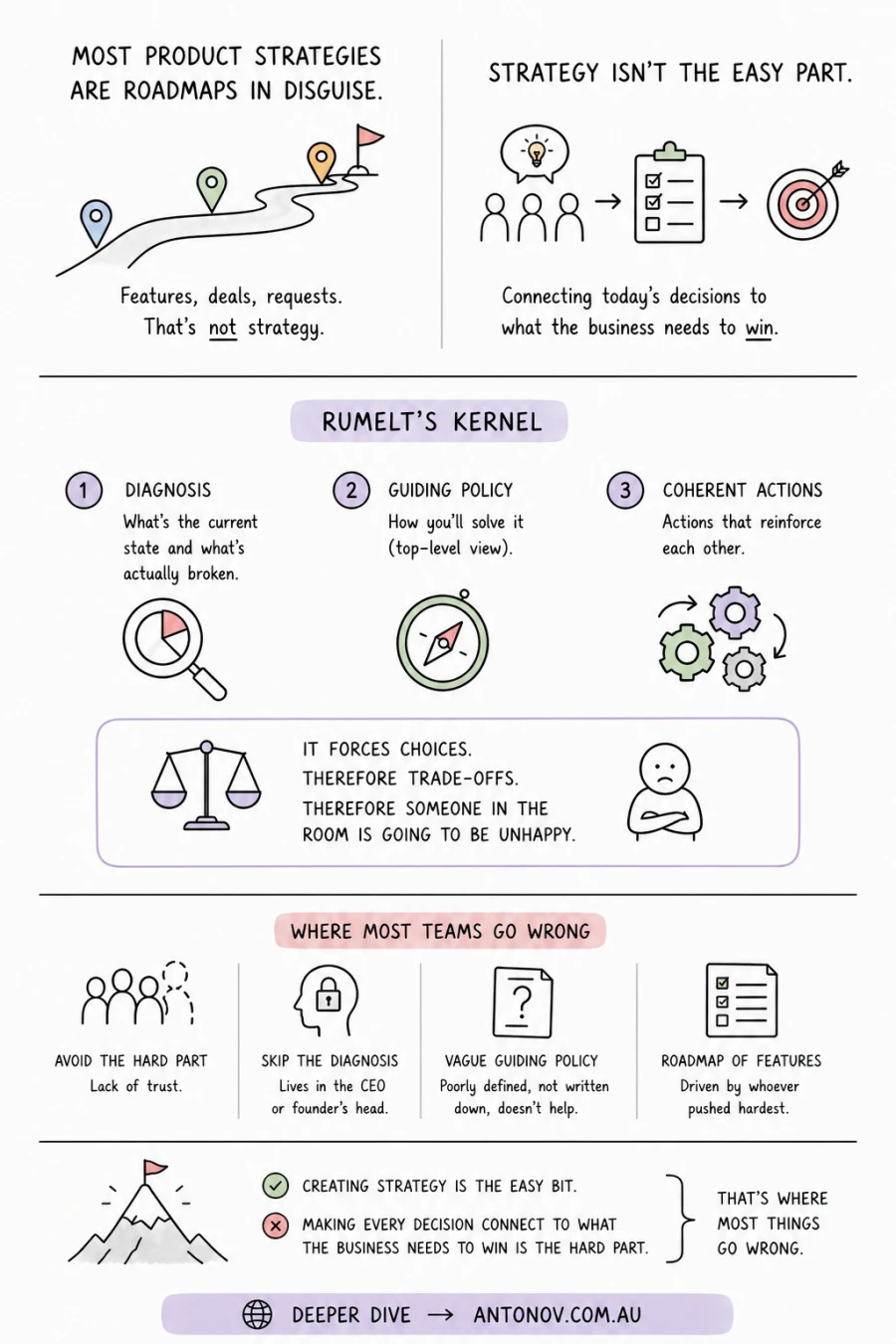
A lot of product strategies I've seen were mostly either a vision, a Product roadmapA view of the product investments, problems or outcomes a team expects to work on over time.Learn more, or some variation of both. Too broad to help make hard decisions or too detailed to understand the direction at a glance.
Even your leadership team is probably using the term "strategy" incorrectly, describing a trending technology like AI, a deal with a large client or a board request as strategic.
But even if the team understands what good strategy looks like, that's the easy part. Running it through an organisation, connecting Tuesday's prioritisation call to the thing the business most needs to win, that's where it gets hard. That's where the interesting problems actually live. Everyone knows this is true.
Rumelt has a name for it: a "kernel." There are three parts: what's the current state and what's actually broken, how you'll solve it (top-level view), and actions that reinforce each other instead of cancelling each other out.
Sounds nice and clean on paper, but in reality it forces choices, therefore trade-offs, therefore someone in the room is going to be unhappy.
A lot of teams, including leadership, tend to avoid or skip that part (why? Mostly because of a lack of trust, read "The Five Dysfunctions of a Team").
Some organisations tend to skip the diagnosis part entirely and it just lives in the CEO or founder's head.
The guiding policy is typically poorly defined, not written down, doesn't help with prioritisation decisions and often changes - if it exists at all.
The coherent actions are just "the roadmap of features" and the roadmap was heavily influenced by whoever pushed hardest in the last planning cycle.
The interesting part is that creating a good strategy is the easy bit. Making sure every decision your team makes actually connects back to what the business needs to win - that's much harder to solve. That's where most things go wrong and most of the failures too.
The gap, the diagnosis, the hard choices most teams avoid, that's what I write about here.
Strategy foundations
Good Strategy, Bad Strategy - Richard Rumelt's Kernel Framework Rumelt's core argument is that most "strategy" is a list of goals dressed up to sound strategic. The real version is narrower, harder and starts with an honest diagnosis of what you're actually up against. Notes from his Lenny's Podcast conversation.
The Purpose of a Strategy What strategy is actually for, and why organisations keep mistaking plans and ambitions for direction.
Simple Strategy by Netflix How Netflix runs strategy: short documents, specific choices, revisable when the world changes. The opposite of the 40-page deck nobody reads after the all-hands, which is more companies than will admit it.
Seven Priorities Is Not a Strategy Why most strategy documents aren't strategies at all. They're lists of intentions with a deadline. The test: if you could replace your company's name with any competitor's name and it still reads true, it's not a strategy.
Strategy: Practical Tips Concrete ways to sharpen a strategy that's already in place, or diagnose one that isn't working.
Communicating strategy
SCQA Framework: Situation, Complication, Question, Answer The most practical tool for communicating strategy clearly, especially when the audience has ten minutes and you need them to grasp both the problem and the direction before they check their phones.
How to Craft a Strategy Narrative That Inspires Action How to move from a strategy document to a story the team can actually hold. Once the slide deck stops being opened, the narrative is all that's left.
Clarity Over Complexity Why clear strategy is harder to produce than complex strategy, and what to do when you can't get everyone to agree on the simple version.
Is Strategy Supposed to Be Difficult to Understand? Why strategy that requires a 30-page document to explain is usually a sign the thinking hasn't finished yet.
Strategy in practice
Why PMs Aren't Driving Strategy (And Why Workshops Won't Fix It) The structural reasons most product managers never get near the strategic work, and why handing them a framework doesn't fix it.
Why AI Won't Save a Bad Product Strategy AI tools can accelerate a good strategy. They can't substitute for one. What happens when teams treat AI adoption as the strategy rather than a capability they apply to one.
Agile vs Strategy How agile methodology and Product strategyA set of choices about where a product will compete, which problems it will focus on and how it expects to win.Learn more should work together, and how they actually work together in most teams. Spoiler: not well, most of the time.
Confusion Kills Strategy What happens when the strategy is technically in place but nobody in the organisation understands it well enough to act on it.
Strategy Grounds Agility Why a real strategy doesn't slow teams down, it's what makes speed possible without everything pulling in different directions.
Strategy and leadership
The CEO Code: Strategy, Operations and Strategy Narrative What great CEOs understand about the relationship between strategy and operations that most product leaders don't, and how the strategy narrative connects the two.
Strategic Balance and Flow How to keep a Product functionThe people, responsibilities and decision mechanisms that turn customer and business context into product direction.Learn more moving between exploration and execution without losing the strategic thread entirely.
Frequently asked questions
What is a product strategy? A specific answer to a harder question: given what we know about our customers, our market and our constraints, what are we going to do, and what are we deliberately not doing? It's separate from a roadmap, which is a plan for execution, and from a vision, which is a long-horizon aspiration. A good strategy is short enough to remember and specific enough to make real decisions from. Most aren't, which is the whole problem.
What's the difference between a product strategy and a product roadmap? A roadmap is a plan. The strategy is what justifies it, which most teams skip entirely, which is why every prioritisation conversation feels like it restarts from scratch. The strategy answers what problem you're solving, for whom and why this approach. The roadmap follows from that. Without the strategy, you're just sorting work by whoever argued loudest in the last planning session.
What makes a product strategy good? Rumelt's test is useful here, more or less. A good strategy has a clear diagnosis of the challenge, a guiding policy that explains how you'll approach it, and coherent actions that reinforce each other rather than cancel each other out. It also makes clear what you're not doing. If the same strategy could apply to any company in your space, it's not specific enough to be useful yet.
How do you communicate product strategy to a team? SCQA frameworkA writing and communication structure built around the Situation, Complication, Question and Answer.Learn more is the most practical tool for this. Start with the context everyone already understands, name the specific problem that needs solving, ask the question the strategy answers, then give the answer. Most strategy communication fails because it leads with the answer and skips the problem, so the team understands what to build but not why, which means the first time something changes they're stuck. The context is what makes direction portable.
How often should product strategy change? More often than most organisations are comfortable with, and less often than most roadmaps do. The diagnosis and guiding policy should be stable enough for the team to actually internalise, usually quarters not weeks. The specific actions should be revisable as you learn. The mistake is either locking the strategy so long it becomes irrelevant, or changing direction so often there's no real strategy at all, just a new slide every quarter.
Why do most product strategies fail? Usually for one of three reasons, though they often show up together. The strategy was never a real choice to begin with, just a mission statement with dates attached. Or it was never connected to what the team actually builds day to day. Or it was communicated once and assumed to be understood. Strategy isn't a document. It's a shared understanding of what you're doing and why, and maintaining that understanding is an active job, not something you sort out at an offsite and move on from.
Work with me
If your product team has a strategy problem, whether that's getting one in place, making sure it connects to what the team builds day to day, or helping a founder think through a direction, I run focused engagements for exactly that.
No retainer. Just the work that needs doing.
