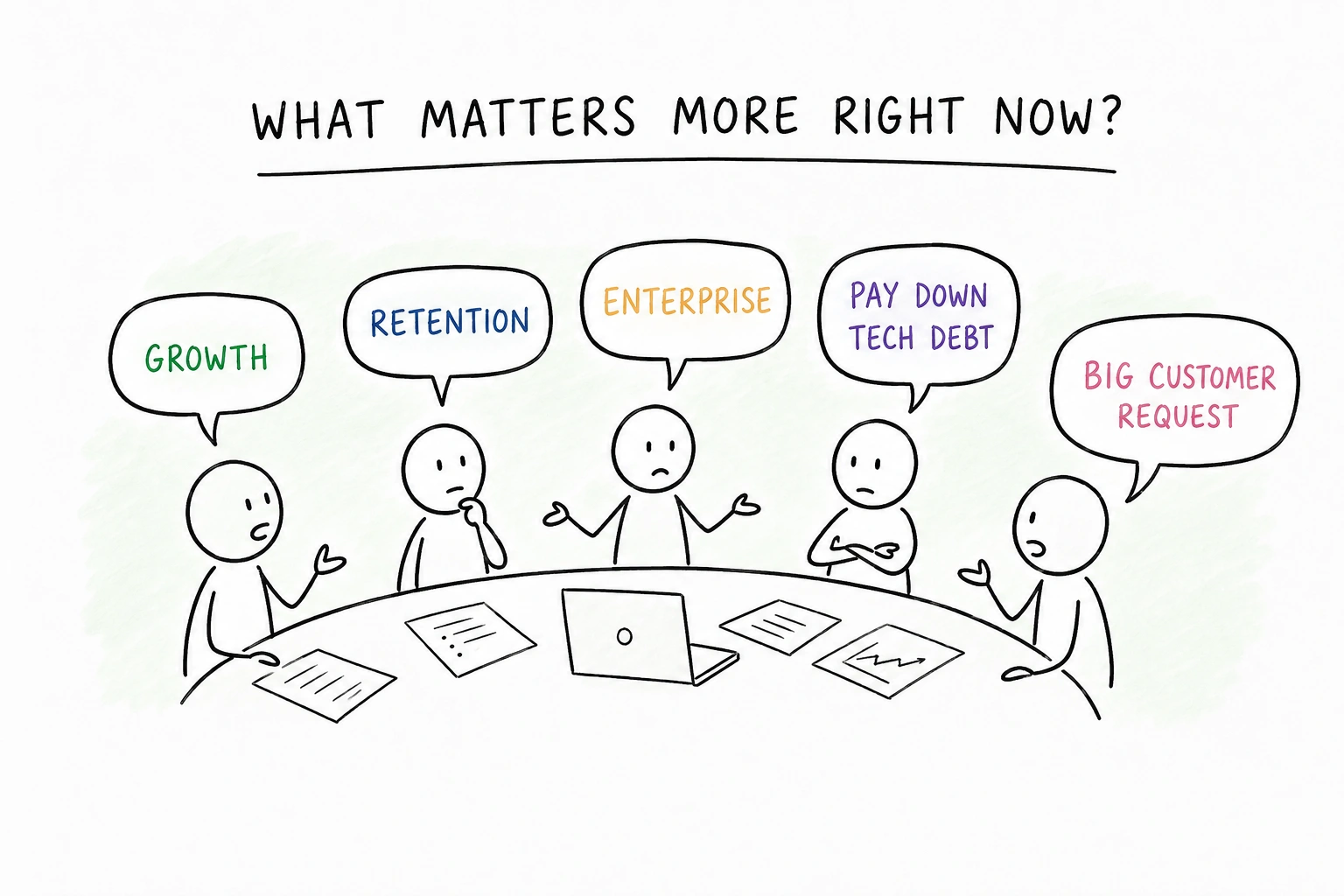
Sometimes you think you have a good strategy in place, but when you ask around the company and ask people to point out the three things we're focusing on and why, you might get different answers.
Or people might give you a bit of a disclaimer: “This is what's important for my department.”
There are many different ways to define strategy, which is not that important here, but my favourite one is Rumelt's: diagnosis, guiding policy and coherent actions.
The guiding policy essentially translates the direction the company has chosen, for better or worse. It gives people something to align around and makes sure the coherent action plan follows that direction, with the discipline to actually execute it.
Strategy often masquerades as goals and people just highlight what's important (typically for them). This project is important. This customer is, of course, important. It's very important to win X. It's extremly important to build feature Y.
And some become urgent too and because apparently urgent isn't enough, it becomes urgent and, you guessed it, fucking important.
The strategy test
Say a large customer asks for something that could help retain that customer. At the same time, there is a user experience issue that other customers have been asking you to resolve for months.
What would you do?
That's where the strategy should start doing some work, helping teams navigate through that decision.
Who are you prioritising right now? Is it enterprise customers? Is it smaller customers? What needs to be true to prioritise one large customer over 100 smaller customers?
The interesting part is that two companies could make completely opposite decisions here and both could be right. They have different strategies and have picked where they want to win for whatever reason.
The trade-off isn't always simple, but what's the alternative?
You can push in both directions and you might get some results. But what it means is you're going to somewhat serve both segments and somewhat underserve both segments.
Now imagine there are two other companies. One serves large customers really well and another serves smaller customers really well. They're probably going to do a better job than you do.
And quite often, it's just a matter of time.
Strategy should create a default state, a reference point for the teams. It's not an absolute rule that you have to follow.
Even if you're focusing on smaller customers, it doesn't mean you can never do anything for a large one.
The lens to look through is: what is so unusual about this opportunity that we're willing to break our default?
Because every step in that direction will slow you down on your journey to execute the strategy.
In a lot of businesses, the team goes back to the founder or CEO and asks them to make the call.
Now the CEO has to context-switch, zoom into the details and try to get up to speed as quickly as possible to unblock the team. You can do that in a smaller company, but the larger the company gets, the harder it becomes. Eventually it becomes impossible for the CEO to be across all these decisions.
The strategy should give the team enough direction to work out which option matters more without going back to the CEO every time. It doesn't need to cover every possible decision. It needs to stop most of these trade-offs from travelling all the way back up the organisation.
But you can also see where leadership starts breaking the strategy.
The CEO or founder comes in and says:
You know what, yeah, I know we're focusing on smaller clients at the moment. We want to keep our 100 smaller customers happy. But there is a really big opportunity with this customer. Come on, let's just do a quick thing, right? It shouldn't be much work.
That's a sign of leadership breaking the strategy, whether they realise it or not and confusing the teams.
The drivers are absolutely understandable. There's a budget. There's a goal to make. There might be board pressure or whatever else is going on. But that pressure cracks through and gets passed into the teams.
If the choice in the strategy was wrong, admit it and adjust it. That's fine. You learned a few things. But don't try to sit on multiple chairs at the same time.
When everyone optimises locally
And if each department is optimising for its local metric or incentives, that's an issue.
A CTO might prioritise tech debt without consulting anyone on whether that tech debt needs to be solved right now, because they feel like, “This is my area and I can make that choice.”
Same with sales. “I need to complete this particular deal, so let's prioritise custom development work so my numbers look good.”
You can imagine how that then feeds into the engineering team or the product team. Everybody is pulling in their own direction. That's a clear sign of a lack of strategy, a bad way of communicating the strategy or a lack of commitment.
Ask people separately
One test I like is asking a few people separately:
"What is the company trying to win at right now?"
If the answers are very different or they start with “It depends”, adding another slide to the strategy document won't help.
You've got to go back to the choices.
Even a complicated business can still have a clear strategy. In fact, the more complicated it gets, the more important it is that people know what matters.