A couple of years ago I sat in a strategy workshop where a facilitator spent about an hour walking product managers through where they sat in the market, opportunities, threats, etc.
It was good content, solid Product deliveryThe work required to turn an approved product decision into something customers can use.Learn more and nicely polished slides.
They also ran an activity with post-it notes where the team voted on the most promising opportunities and got a basic heatmap but the energy was quite low. That kind of energy you get when people can't wait to go back to their desks.
I checked in with the CPO 6 months later but the problem was still the same - PMs still weren't driving strategy or even motivated to explore this. They were great at shipping but kept waiting to be told what to build - the kind of navigating ambiguity in decision-makingAmbiguity & Decision MakingAmbiguity is hardest in startups no users, no strategy, no one to ask. How to make confident product decisions when the situation is genuinely unclear. that strategic work requires felt uncomfortable and uncharted.
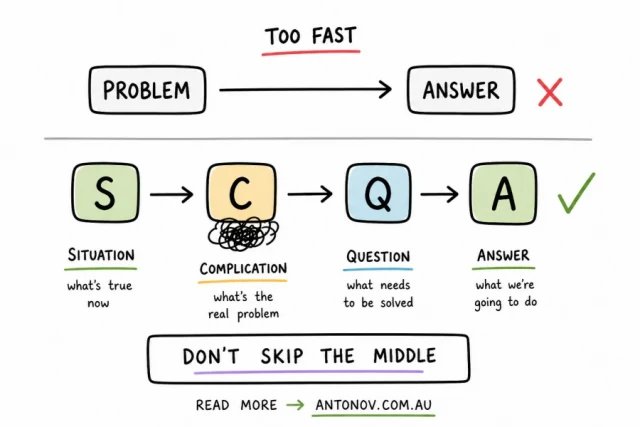
"They just need to think more strategically" is a sentence that I and I'm sure you have heard a lot but without a shared structure like the SCQA frameworkSCQA Framework Explained: Situation, Complication, Question, AnswerStructure any argument in 4 steps: Situation, Complication, Question, Answer. The SCQA framework used by McKinsey consultants with examples and a template. to make that thinking legible, it stays advice and never becomes practice.
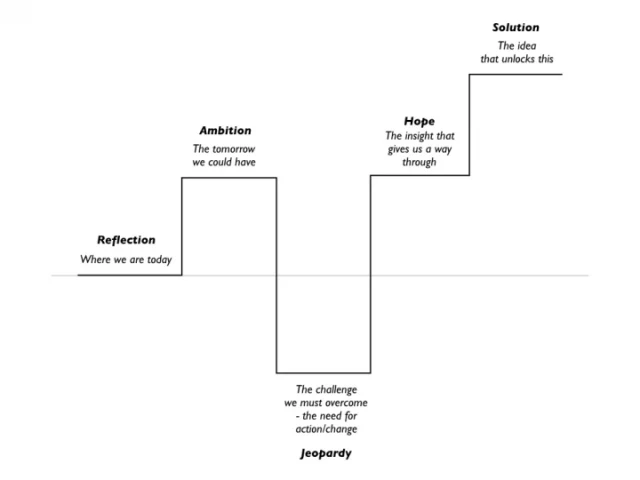
It always pops up in performance reviews, in leadership offsites, in 1:1 where the manager is trying to be helpful and the PM leaves with a vague sense that something important was said but no actual idea what to do with it, building a strategy narrativeHow to Craft a Strategy Narrative That Inspires Action gives them something concrete to walk out with.
The diagnosis is usually right, more or less. The fix almost never is and I've been trying to work out why for a while now.
BJ Fogg spent years testing a theory about why behaviour does or doesn't change. He was mostly looking at personal habits, exercise and flossing and things like that, but the pattern holds further than that.
The short version is that a behaviour only happens when 3 things are present at the same time.
The person has to want to do it. They have to be able to. And something has to trigger it right now, not in theory.
If you pull any one of those out and the behaviour doesn't happen.
Let's start with motivation. Most PMs who aren't thinking strategically don't think it's their job. Not because they're incapable but because the incentive system points entirely somewhere else: delivery, velocity, features shipped, etc. Keeping the Product roadmapA view of the product investments, problems or outcomes a team expects to work on over time.Learn more from turning into a backlog swamp and making sure stakeholders are happy. And sometimes PMs feel more safe in the delivery space as it's more predictable and less vague.
I've watched smart PMs get narrower and narrower over 12 months because the gravitational pull of the delivery machine just dragged them in, not because anyone pushed them down but
You won't have a deep conversation about where the market is going during a sprint review, most of the time you spend talking about what shipped and what didn't.
Ability is real too and I want to be clear about that. Product strategy is a craft, actually, not just a mindset you switch into. Most PMs were never shown how to find a genuine insight versus a restatement of a brief. Nobody explained what it means for a strategy to have a diagnosis and guiding policy.
So. The prompt.
A prompt is the thing that should make something happen today rather than eventually. And what I keep noticing is that PM rituals are wired entirely for execution like your typical sprint reviews, stand-ups, Weekly check-ins , etc.
None of those meetings have a moment where someone turns to the PM and says "so what's your actual read on where this market is heading?". Big question, I know but The strategy question does not exist in the schedule. It's not in the agenda. It's not in the template. The prompt is just absent.
I've watched PMs do the strategic thinking privately on their own time and write it up then send it into a Notion doc with a catchy title. 3 people give it a thumbs-up and it's never opened again.
I said earlier that ability is real and needed and I still think that is true, but the more I ponder this, the less certain I am that it is the main issue.
I believe motivated people with regular prompts tend to find their way to the skill. When the skill sitting there unused is basically the same as not having it at all.
Anyway. I've seen this work exactly once at a company that sort of stumbled into it rather than designed it.
The CPO started asking one question in every quarterly review: "where do you think this market is going in 12 months?" And then waited. Didn't accept "we're focused on retention" as an answer. The first couple of times the PMs scrambled and gave non-answers and left looking flustered. Third quarter, the answers got interesting. By the end of the year two of those PMs were doing the thinking that used to stop at the CPO's desk.
That's motivation plus prompt, in one recurring moment. And yes, you still need the capability side too but it's the one that already gets all the workshops.
I don't have a clean resolution here tbh. Most organisations aren't set up for this and changing the setup is genuinely hard and the people who have the power to change it don't always understand what exactly they'd be changing.
But I'd start with the prompt. It's the one nobody's looking at.
Sometimes you think you have a good strategy in place, but when you ask around the company and ask people to point out the three things we're focusing on and wh...
A company I spoke with last quarter had their AI strategy ready. Slides, a dedicated section, a product vision that was going to be powered by AI. The founder h...
I ran a strategy audit for a company where the CEO was convinced they had a strategy but the team couldn't follow it.
The deck was about 10-12 slides. Three of...
I'm a father of 3 from Sydney, a product and technology leader. I write about
leadership, product management, technology and the messy reality of making work work.
I'm currently building and experimenting with a mildly alarming number of things. I also work as a
fractional product leader, stepping in where the
founder or CEO is still carrying product
decisions on their own, and offer 1:1
product leadership coaching for senior PMs and emerging product leaders. I founded SoundingBoard, practical peer exchange for product people. Connect via LinkedIn, or follow me on X.
Subscribe to the best posts on product, strategy, and AI. Just one email a month.