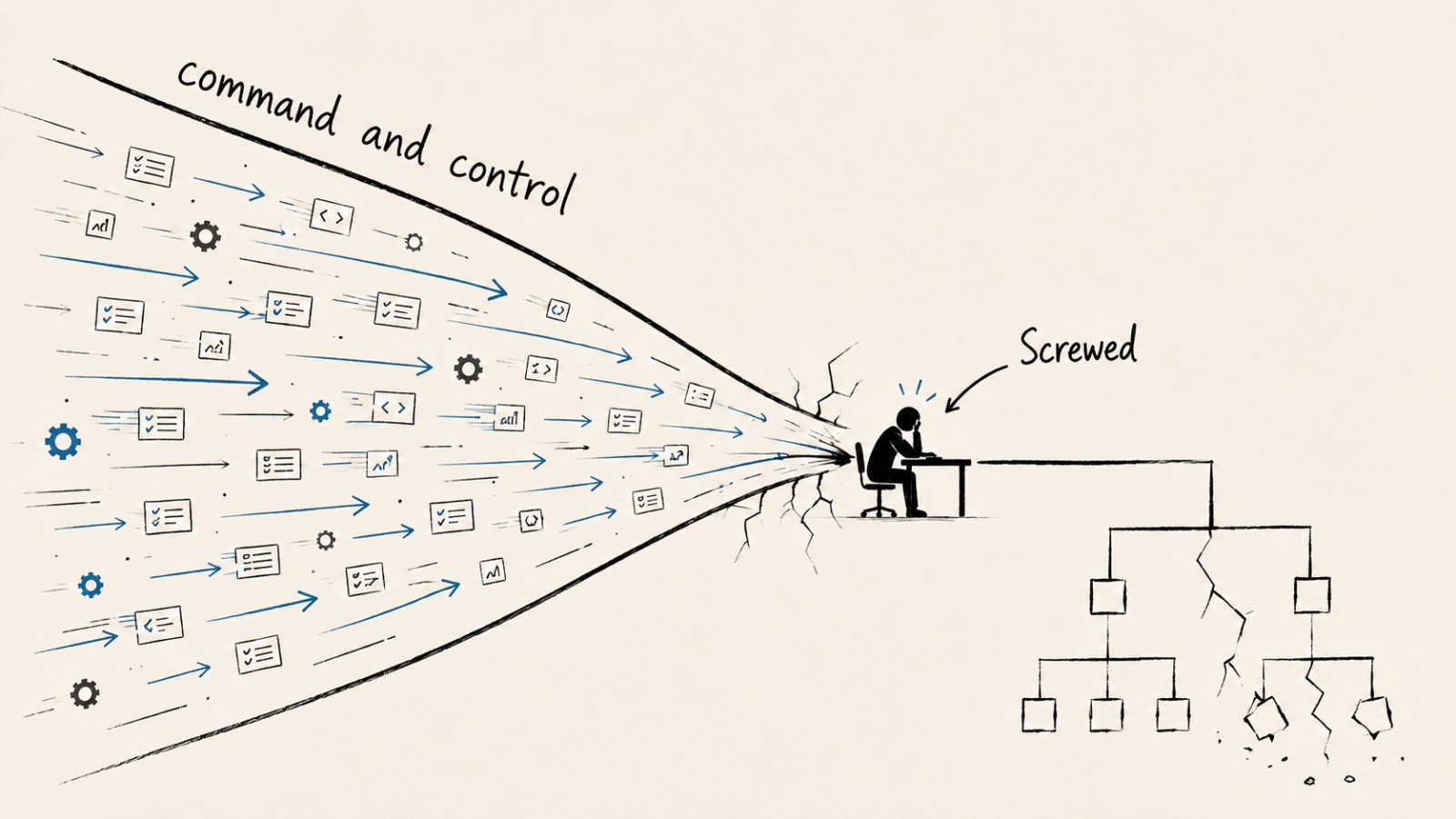
Imagine a company where the CEO reviews requests and features, keeps track of what the product and engineering teams are doing and gets involved in a lot of the detail.
As the speed of development gets faster, the number of reviews and decisions the CEO has to make goes up as well. That slows them down. The CEO becomes the bottleneck and essentially, you get screwed.
A good test today: what if your engineering team could do 10 times more than they currently do? What would you do?
I've always found this a useful scaling test in companies I've joined. Say you had 10x the people or 10x the output. Where would the bottlenecks be? What would break?
Leadership can't scale its involvement at the same rate as engineering capacity.
A better way to structure it is to ask: what are the bigger strategic items you care about, particularly those associated with additional spend, risk or exposure? You should be involved in those.
It's also about whether it's a One-way door and two-way door decisionsA way to separate difficult-to-reverse decisions from decisions that can be changed relatively easily.Learn more, where it's hard to reverse the decision.
Let's say it's optimising a particular metric and the team knows quite a bit about the customer, technology and data. Let them make decisions and experiment.
As capacity increases, you have to adjust your communication and leadership style. Instead of relying on verbal communication, more of it has to be written because you can't rely on leadership being in the room to provide context or make every decision. That doesn't mean getting rid of verbal communication. It still makes sense where applicable, but the main workflow needs to be written.
Companies that still require leadership to be involved in most decisions will struggle against companies that give teams context and intent, set clear goals and strategy and let them make decisions without constantly asking leadership for permission.
Their teams will have more autonomy and make decisions much faster.
We need to remember that even with AI and all the tools, from coding to consolidating customer feedback to highlighting what's important and writing Objectives and Key ResultsA goal-setting framework that pairs a clear objective with measurable results showing whether progress was made.Learn more for the teams, it doesn't automatically make companies faster.
Yes, it will increase the amount of work they can do, but it will also increase the cognitive load. Whether it helps you move faster and build the right things depends on how quickly you can make these decisions.
Command and control worked better when execution was expensive and slow because there were fewer decisions to make and fewer things reaching production. But now the game has changed. You've got to get to production quickly. You can test your ideas pretty easily.
There's a theory called Kessler syndrome.
The core idea is that when enough debris accumulates in orbit, it causes collisions, creating more collisions and the...
One thing I'm learning from building Sounding Board (peer exchange for product people)...what product people actually need is someone who's been through their e...
Why is coding with AI becoming normal, while writing with AI is treated like cheating?
I've gone back and forth on this.
When AI first became available, I exper...
I'm a father of 3 from Sydney, a product and technology leader. I write about
leadership, product management, technology and the messy reality of making work work.
I'm currently building and experimenting with a mildly alarming number of things. I also work as a
fractional product leader, stepping in where the
founder or CEO is still carrying product
decisions on their own, and offer 1:1
product leadership coaching for senior PMs and emerging product leaders. I founded SoundingBoard, practical peer exchange for product people. Connect via LinkedIn, or follow me on X.
Subscribe to the best posts on product, strategy, and AI. Just one email a month.