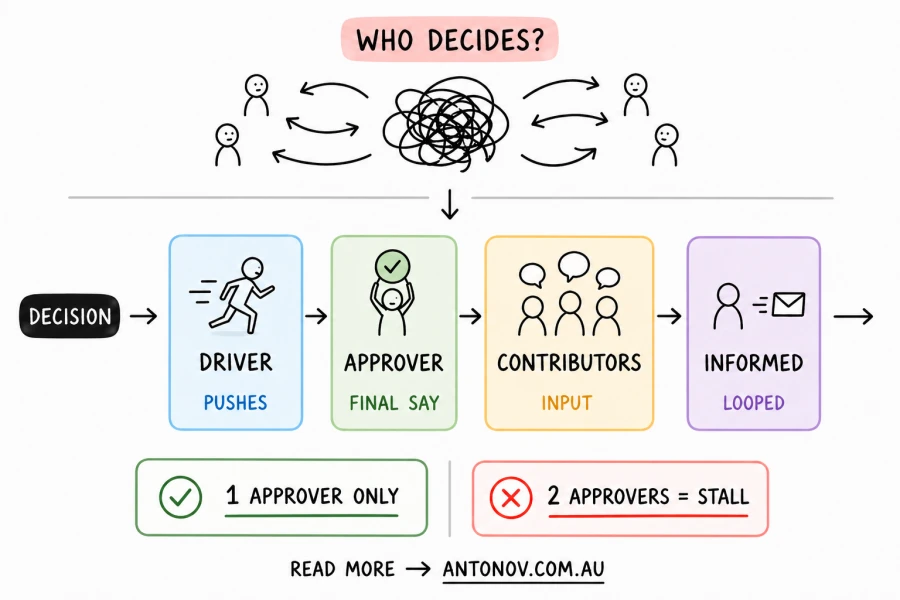
The DACI frameworkA decision framework that assigns a Driver, Approver, Contributors and Informed stakeholders.Learn more model may seem like it belongs in a government procurement document, but it doesn't. It is actually a decision-making framework that is quite useful for product teams.
DACI pairs naturally with the broader challenge of navigating ambiguity in decision-makingAmbiguity & Decision MakingAmbiguity is hardest in startups no users, no strategy, no one to ask. How to make confident product decisions when the situation is genuinely unclear. the framework gives you clarity on who decides; the ambiguity work helps you understand what to decide.
It's easy to use and stops confusion about roles and responsibilitiesProduct Development Roles and ResponsibilitiesThe roles and responsibilities of product development, including the roles of team members and product managers. within a team working on a product or project.
Actionable Takeaway: Most decision loops that drag on are simply missing a named Approver. Can you write down who has final say? If you can't, that's usually the actual problem.
Driver
The Driver is whoever keeps the decision moving. They're the one sending the "just bumping this up" email at 4pm on a Friday.
Actionable Takeaway: The Driver is not the be the most senior person in the room - it should be whoever has the most context. Seniority and Decision rightsAn explicit agreement about who makes a decision, who contributes context and who must be informed after it is made.Learn more often get confused and you need to separate them deliberately.
Approver
The one with the final say, who signs off, breaks ties and takes responsibility for the outcome.
Actionable Takeaway: There should be exactly one Approver per decision. If you have two, you don't have an Approver - you have a committee and committees are slow.
Contributors
The people who provide ideas and context. Keep this group small because it's not a group vote.
Actionable Takeaway: Ask yourself: does this person have information that the Driver genuinely cannot get elsewhere? If not, they are probably Informed, not a Contributor. A Contributors list should not grow beyond 3-5 people. If it does, it is a sign that the decision scope needs tightening.
Informed
Those people are kept in the loop when a decision is made.
Actionable Takeaway: Send a short summary to your Informed group within 1-2 business days of a decision landing to keep them in the loop. Mention what was decided, why, and what happens next. The "wait, when did we decide that?" question is almost always a comms failure and should be resolved.
Nobody who has ever sat in a room full of nodding heads and supposedly reached an agreement, only to watch nothing happen for three weeks, is surprised by this....
If you've ever felt like something's off in your team...a process dragging, communication breaking down or decisions getting delayed but didn't say anything bec...
First of all, make sure that you understand the founder's context, the things the founder cares about and worries about, and the overall vision.
One of the mos...
I'm a father of 3 from Sydney, a product and technology leader. I write about
leadership, product management, technology and the messy reality of making work work.
I'm currently building and experimenting with a mildly alarming number of things. I also work as a
fractional product leader, stepping in where the
founder or CEO is still carrying product
decisions on their own, and offer 1:1
product leadership coaching for senior PMs and emerging product leaders. I founded SoundingBoard, practical peer exchange for product people. Connect via LinkedIn, or follow me on X.
Subscribe to the best posts on product, strategy, and AI. Just one email a month.