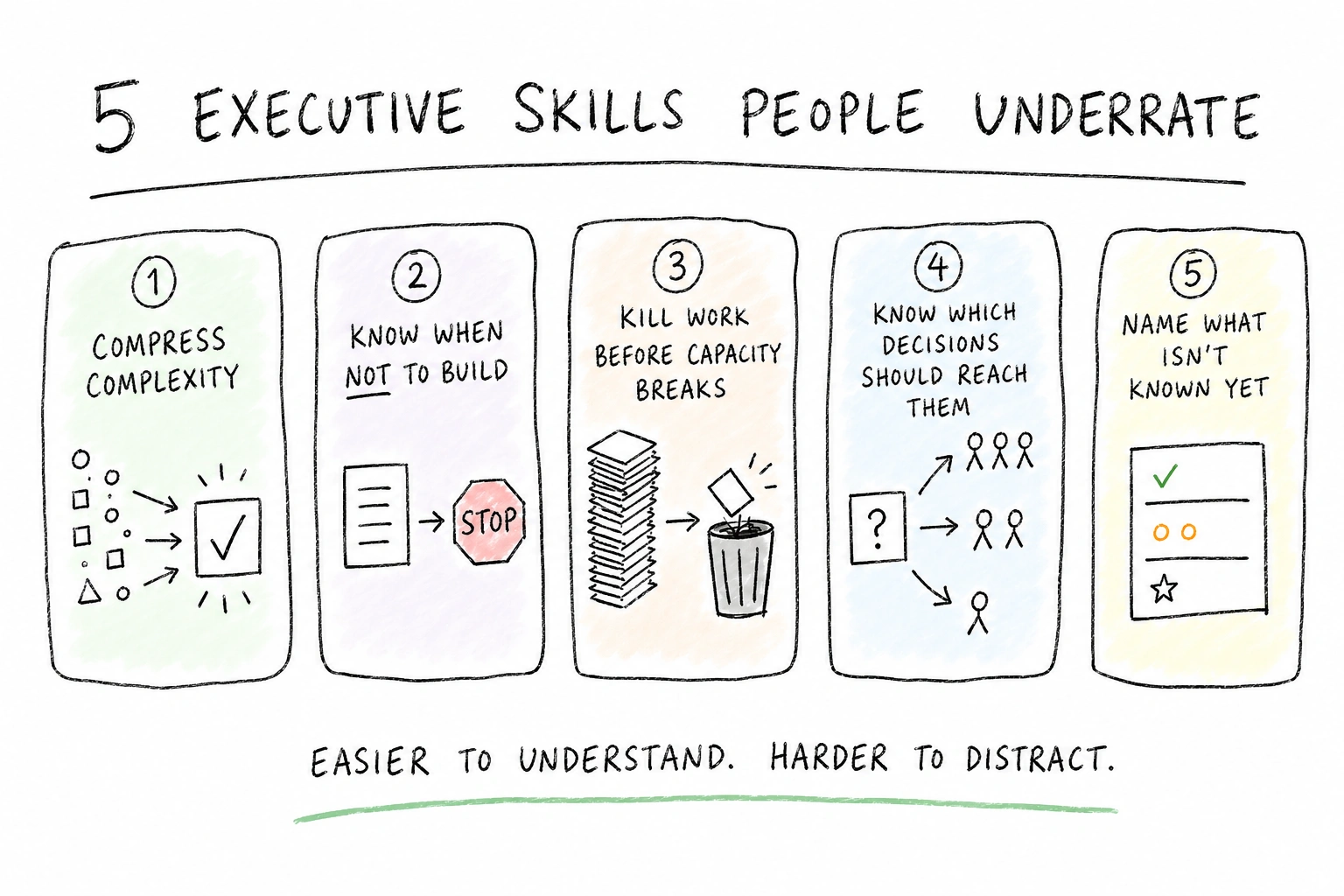
Some executives make a company easier to run. The best executives do not need the biggest vision or the answer to every question. They clarify the decisions that matter, stop unnecessary work and make sure everyone knows what happens next.
A lot of that work is easy to miss. It rarely appears in a strategy deck or gets announced at an all-hands. But you notice when it isn't there.
Compressing complexity
Executives usually have more context than anyone else in the room. Customer complaints, revenue pressure, technical constraints, commitments made to the board, a large client asking for something expensive, 3 teams telling different versions of the same problem.
The skill is reducing all of that to the decision that needs to be made, without hiding the trade-off. A weak version sounds like:
We need to improve the enterprise experience.
A useful version sounds like:
Enterprise customers are taking too long to reach value. We can improve onboarding or build the requested reporting feature, but we do not have capacity for both this quarter. Onboarding affects more customers and is more closely connected to renewal, so that is where we will invest.
The complexity still exists. People know what to do with it.
Knowing when not to build
Most companies are better at turning problems into engineering work than they are at deciding whether software is the right response.
A customer asks for a feature, sales forwards the request, someone estimates the effort, and a few weeks later it's on the Product roadmapA view of the product investments, problems or outcomes a team expects to work on over time.Learn more. Good executives interrupt that sequence.
They ask what the customer is trying to achieve, how often the problem occurs and what behaviour needs to change. They ask whether pricing, onboarding, operations or account management could solve it faster.
Sometimes the right decision is still to build. Other times the requested feature is really a training problem, a packaging problem, or one enterprise customer trying to make its internal process your product's problem. Engineering capacity is an investment. Knowing when not to spend it is part of the job.
Killing work before capacity breaks
Most executives can see when a team is stretched. The underrated skill is doing something about it.
A team rarely becomes overloaded because one project was unexpectedly difficult. It happens one reasonable commitment at a time: the important client request, the strategic initiative, the small improvement that should only take a week, the project that started last quarter and is somehow still going.
Eventually, everything is important and the team is carrying seven priorities with enough capacity for three. At that point, encouragement does not help. Neither does another planning session. Someone needs to stop work, reduce scope or renegotiate a commitment. Executive support becomes real when they remove work that no longer deserves capacity.
Knowing which decisions should reach them
Some executives become the approval step for everything. Others delegate every decision and call it empowerment. Both create problems.
Strong executives know which decisions the team should make without them, which ones require a cross-functional trade-off and which ones could materially change the company.
A copy change should not wait for an executive. A 3-month investment for one customer probably deserves a broader commercial discussion. A pricing decision that could affect retention, sales incentives and support costs should not be left to one function. The skill is designing a company where decisions reach the right level. When that works, teams move faster without taking risks they do not have the context or authority to own.
Naming what isn't known yet
Executives are often expected to sound certain before certainty exists: the roadmap will be delivered, the new segment will grow, the partnership will close and the feature will improve retention. But confidence is not the same as knowing what's actually true. A useful executive separates what is known from what is assumed.
They can say:
We believe this could reduce churn, but we do not yet know whether the missing capability is the reason customers leave. We will speak to ten churned accounts before committing to the full build.
Or:
The June date is possible, but it depends on the integration work finishing by mid-May. If that slips, the launch moves.
People can plan around what isn't known, as long as it's visible. What damages trust is presenting assumptions as commitments and explaining the difference after they fail.
None of these skills is particularly glamorous. They do not produce a memorable keynote or a new framework with someone's name attached.
They make the organisation easier to understand and harder to distract. People know what matters, teams know what to stop, decisions happen at the right level, engineering capacity goes towards problems worth solving, and risks appear before they become surprises.
A leader, especially an executive, admitting they got something wrong, out loud, in front of the team, is rarer than it should be. When a mistake happens, every...
When I read the job description, it said I'd own product strategy. The organisation chart backed that up but the founder hadn't handed it over.
I noticed it in...
"Wait, I thought we agreed on this..."
You did, but memory is a terrible place to store a decision.
Decisions that live in a meeting disappear and nothing slows...
I'm a father of 3 from Sydney, a product and technology leader. I write about
leadership, product management, technology and the messy reality of making work work.
I'm currently building and experimenting with a mildly alarming number of things. I also work as a
fractional product leader, stepping in where the
founder or CEO is still carrying product
decisions on their own, and offer 1:1
product leadership coaching for senior PMs and emerging product leaders. I founded SoundingBoard, practical peer exchange for product people. Connect via LinkedIn, or follow me on X.
Subscribe to the best posts on product, strategy, and AI. Just one email a month.