I'm a father of 3 from Sydney, a Product Director and a Product Coach. I write about leadership, product management and the messy reality of making work work.

I'm currently building and experimenting with a mildly alarming number of things.

Connect via LinkedIn or follow me on X.

Subscribe to the best posts on product, strategy, and AI. Just one email a month.

  1. TL;DR

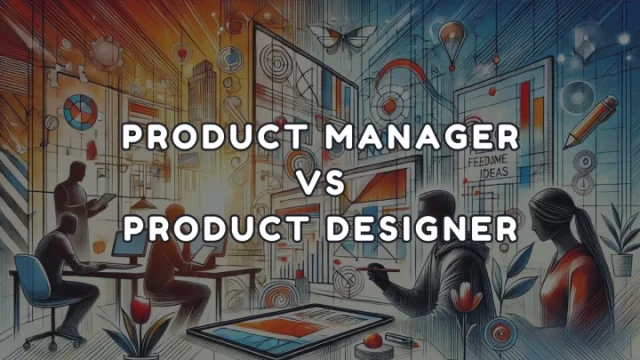
    Role clarity is oxygen. Let PMs own direction and PDs own experience. Protect calendars, write before debating, adjust volume by phase and track one metric that matters. Ship faster, sleep better.

    1. Draw the Line Early

    Product Manager (PM)

    • Core focus: market and viability risk
    • Typical questions: “Will people pay for this?” “Does it move the North-Star metric?”
    • Key output: one-pager covering purpose, success metrics and trade-offs

    Product Designer (PD)

    • Core focus: usability and desirability risk
    • Typical questions: “Can customers complete the task?” “Where do they stumble?”
    • Key output: clickable prototype showing flow, copy and edge states

    2. Guard the Calendars

    Red flag: PM trapped in Figma tweaking icons. Red flag: PD buried in cost–benefit spreadsheets. Fast filter:

    • If the task changes product vision, it belongs to the PM.
    • If the task changes product surface, it belongs to the PD.

    This discipline frees the roadmap and keeps creative energy high.

    3. Write First, Talk Second

    • PM posts a succinct one-pager to Slack outlining problem statement, success measures and known constraints.
    • PD replies with a Figma link showing interactive flow, micro-copy and empty-state behaviour.
    • Only then schedule a 30-minute debate. Decisions lock in, iteration time halves.

    4. Phase-Based Volume Control

    • Framing / Discovery – PM's voice dominates; market-sizing memo appears.
    • Ideation & Prototyping – PD leads; high-fidelity Figma frames drop.
    • Build & Polish – PD still loudest; design-system tokens freeze.
    • Launch & Iterate – PM turns the volume back up; KPI dashboard lights up.

    5. Share One Scorecard

    Choose a single, public metric - activation lift, task-success rate or first-week retention. Both crafts pull the same lever, killing silos and politics.

    6. Outcomes You Can Expect

    • 25–40 % faster time-to-decision (anecdotal data from five Aussie SaaS teams).
    • Higher designer morale: fewer context switches, deeper craft.
    • Sharper product bets: PMs stay market-obsessed, avoiding “feature museum” creep.

    Recommended Tools & Rituals

    • Figma for rapid prototypes (PD).
    • Miro/FigJam for story mapping (shared).
    • Amplitude or Mixpanel for the single metric (PM).
    • Weekly 15-minute “Line-Check” stand-up: confirm who owns which decisions this sprint.

  2. Jun 25, 2024

    The Role Overlap Between PM and PD

    Roles in product and design teams often overlap. Both product managers and product designers talk to customers, come up with feature ideas, and suggest UX improvements. However, these overlaps can som...
  3. Jun 24, 2024
    Culture

    Working at a small tech business shapes your career differently.

    You'll juggle strategy, customer service, product development and beyond. The small team demands versatility, immersing you in every aspect of the business. This hands-on experience accelerates learning and builds skills quicker than larger organisations ever could.

    For ambitious minds craving growth and variety, nothing compares.

    In a small tech business, every hat you wear accelerates your growth
  4. Jun 23, 2024

    Why Do I Run?

    I used to play soccer, where running was an integral part of both training and the game. However, I never saw the appeal of going for a jog just for the sake of it. We had to run 6km as a warm-up bef...
  5. Jun 22, 2024

    Why You Should Join a Small Tech Business

    When you work in a small tech business or a startup, one of the pros is that you are involved in all aspects of the business, from strategy to customer service. In our team at Backpocket, when we make...
  6. Jun 19, 2024

    If the user experience needs explaining, it's not a good one.

    Clarity should be baked into design. The best experiences guide users seamlessly, answering questions before they arise and making every interaction intuitive.

    Explanations only highlight what's broken. A great user experience speaks for itself.

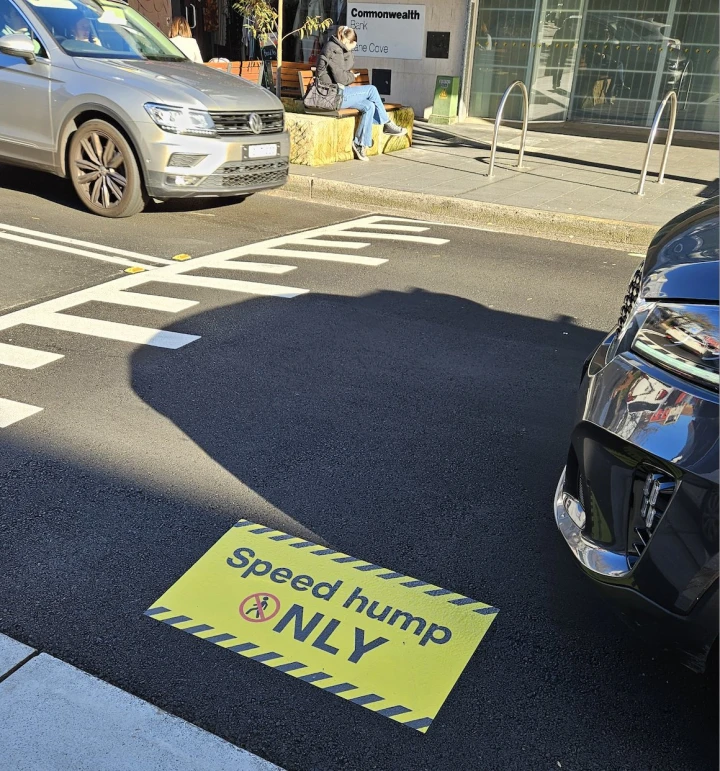
    Pedestrian crossing or not?

    Pedestrian crossing or not? Sydney
  7. Jun 15, 2024

    Tactical decisions for short-term revenue often clash with long-term strategy. They're unavoidable in business. Balancing these moments without losing sight of the bigger picture defines strong leadership.

  8. Jun 14, 2024

    Love this quote from "Ego is the Enemy" by Ryan Holiday as it helps stay humble and open to feedback from others.

    The first principle is that you must not fool yourself - and you are the easiest person to fool.

  9. Jun 14, 2024
    Product Strategy

    The CEO Code, The Unit of Impact, Lighthouse Customers, Strategy & Operations and Strategy Narrative

    Key Takeaways #2 #1 The CEO Code Going through my notes from various books, I found this one from "The CEO Code" particularly interesting because it highlights the importance of accessibility and pers...
  10. Jun 13, 2024

    Product-Led vs Sales-Led Growth: How to Choose the Right GTM Motion

    I spoke to someone about sales-led vs. product-led organisations today. I used to be in the product-led camp, but not anymore. Today, I think differently. As with anything in the world, it's not that...
  11. Jun 11, 2024
    Communication

    Broken Isn’t Always Yours

    If you've ever felt like something's off in your team...a process dragging, communication breaking down or decisions getting delayed but didn't say anything because “it's not your job to fix it,” you'...
  12. May 30, 2024
    Observations

    Indie Hacker Habits

    You might not know Tony Dinh, Danny Postma, Pieter Levels or Marc Lou. But they are successful indie hackers and solopreneurs. Here's what they do really well: They share their wins and losses on soc...
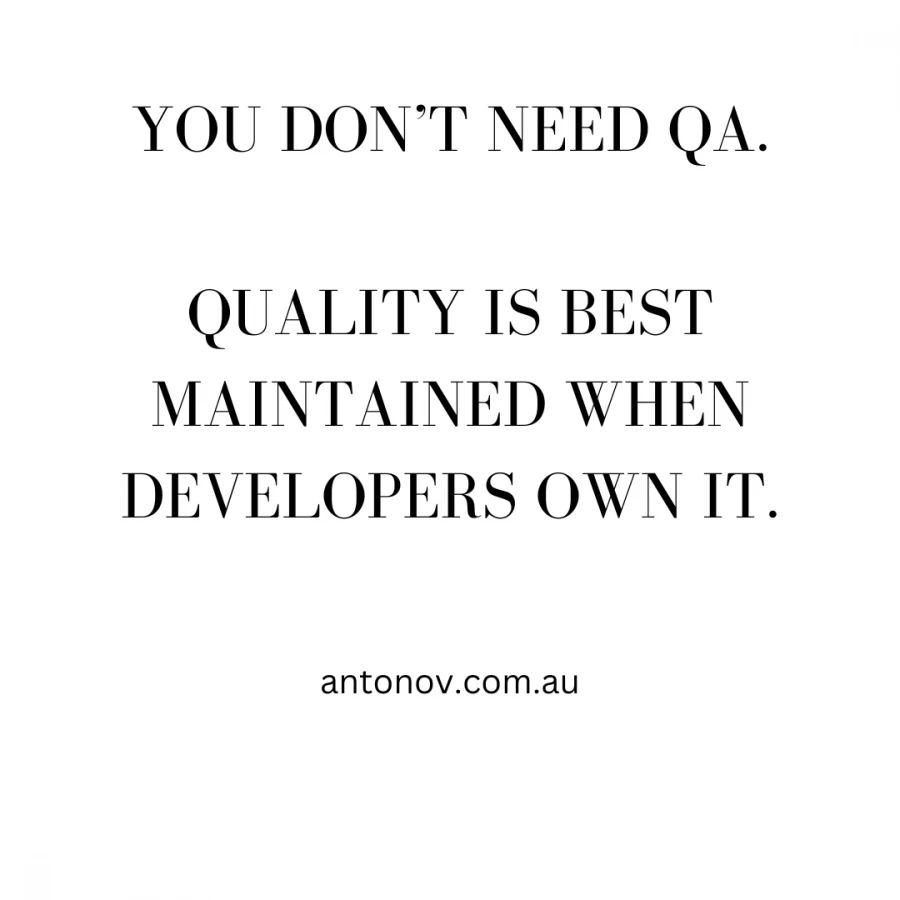
  13. Dedicated QA creates more problems than it solves.

    When a dev team owns quality, accountability stays in the right hands. Bugs are fewer, fixes are faster and processes tighten.

    Introducing dedicated QA shifts that balance.

    Developers grow complacent, relying on testers to catch mistakes. Tools diverge, creating inefficiencies. QA often duplicates what devs should already handle.

    Quality isn't a separate role. It's a shared responsibility embedded in every line of code.

    You don't need QA
  14. May 7, 2024

    TIL: "Lighthouse Customers" - customers who get a better or discounted rate on your product in exchange for regular, meaningful feedback.

    Lighthouse customers give you a strategic edge. These early adopters don't just use your product - they help shape it. Their feedback highlights gaps, confirms your direction, and sharpens your focus. In return, they get early access to a solution that feels designed just for them, often at a special rate.

  15. May 6, 2024

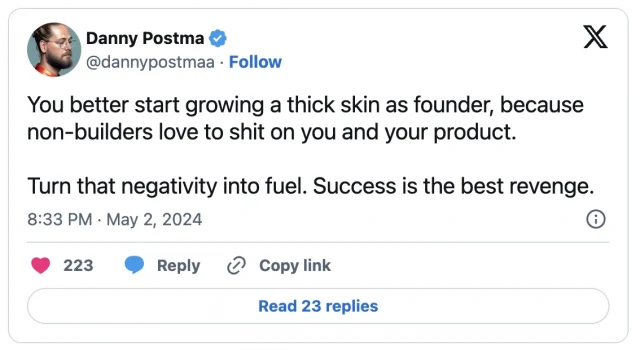
    The Effective Manager, How to Pivot, Thick Skin, Team Alignment and Ship First

    Key Takeaways #1 #1 The Effective Manager Take care of your team, set goals, and help them achieve those goals. The definition of an effective manager is one who gets results and keeps their people. Y...
  16. May 1, 2024

    Ambiguity makes people freeze. But it doesn't have to.

    Not knowing what's right or what's next stalls. That hesitation drags. Pair reflection with motion - thinking and doing - and clarity shows up faster than you expect.

    Track your bets. Review what worked and what flopped. But keep moving. You don't need perfect answers. Just honest ones. Then act.

  17. Apr 29, 2024
    Takeaways

    10 Insights from "Lessons Learned from 1,000+ YC Startups with Dalton Caldwell"

    I recently listened to Lenny's podcast, where he spoke to Dalton Caldwell, Managing Director at Y Combinator, and discovered a few interesting insights. Here are 10 of them: #1 Airbnb To succeed in a...
  18. Jan 10, 2024
    Faster Decisions

    Commitment is a function of two things: clarity and buy-in

    "Commitment is a function of two things: clarity and buy-in" -- Patrick Lencioni, The five dysfunctions of a team Clarity in either a project or an organisation ensures that the involved parties under...
  19. Jan 8, 2024

    Forces That Block Change

    We will always be more comfortable with what already exists, even if it's 💩. Typically, we are not actively looking for better ways to solve problems we face. And this could be due to a number of rea...
  20. Jan 7, 2024

    Go Bold

    If you're putting a lot of effort into creating a new product or feature to solve a customer problem, ensure you have the bold solution under your sleeve too. Even on paper (or in Figma), bold ideas p...

Search

Explore pillars

Start with the bigger ideas